.svg)
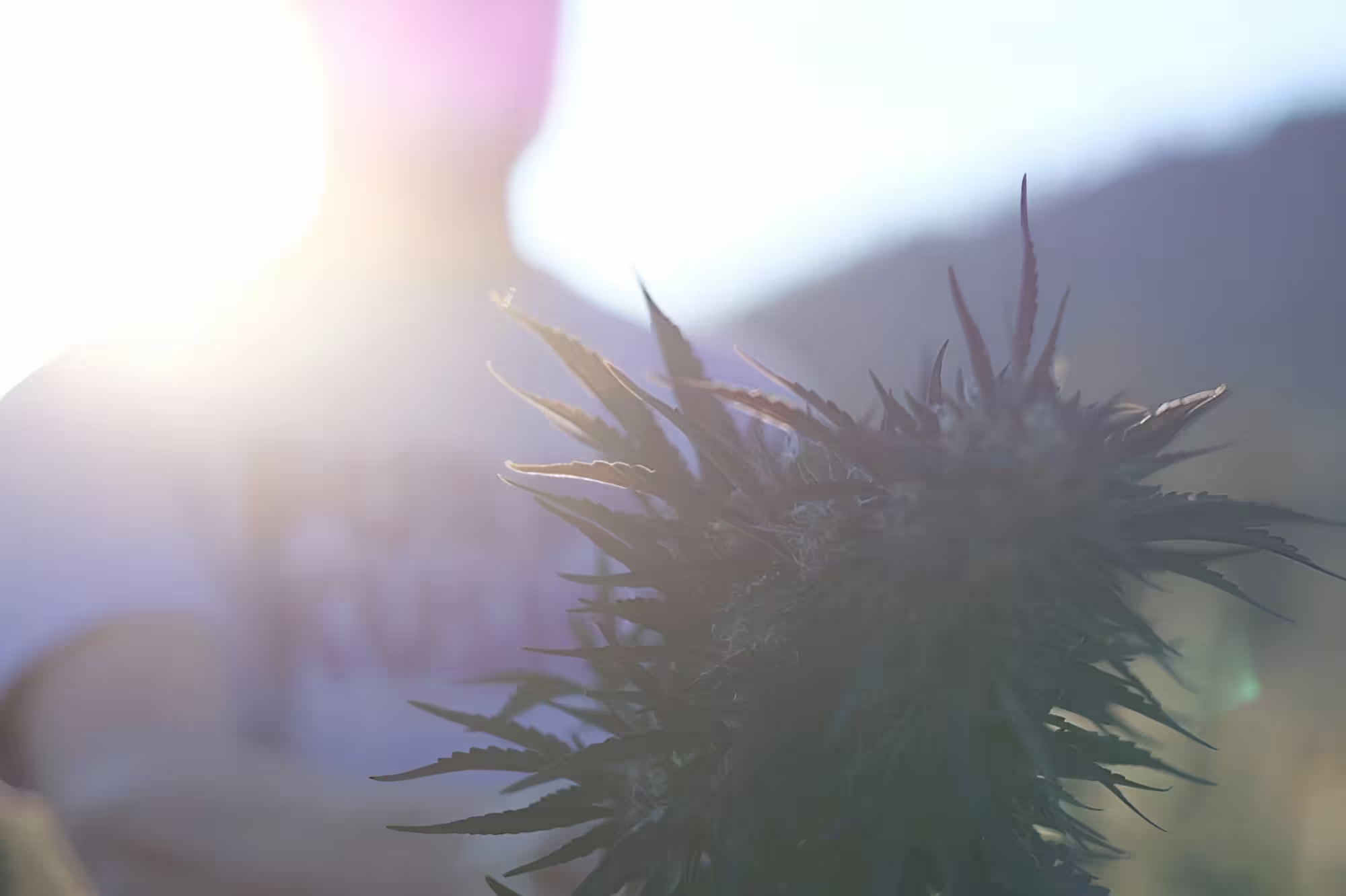


Quick answer: THC percentage on a cannabis label is supposed to represent the batch average — but the system was built for a liquid, not a living plant. A plant's potency varies naturally from top to bottom, the testing system is easily manipulated, and consumer obsession with a single number has pushed the entire industry in the wrong direction. Quality cannot be defined by THC alone.
There's a reason a pre-roll can say 32% THC and still smoke flat. No flavour, harsh on the throat, a weak buzz that doesn't match the label.
It's not bad luck. It's a flawed system built around the wrong number.
The Booze Math Doesn't Work On A Plant
The THC system was built like alcohol labelling — one number, applied evenly across the whole product. Makes sense for a beer. 5% is 5%, bottle or keg. Liquid is liquid.
Weed isn't a liquid. It's a living plant, and potency isn't spread evenly through it. The top gets hammered with light and produces real resin. The bottom sits in shadow and produces almost nothing. That's just how the plant works.
Once the only number that matters is THC%, the whole industry starts chasing the number instead of growing the plant right. And a system built for a liquid was never going to work for a plant that grows unevenly.
The Legacy Market Already Had The Answer
Before lab stickers and licensed producers, there was a grading system that actually worked.
Dubs. Trips. Quads.
Growers in Nelson and on the Sunshine Coast built their reputation on brutal sorting — throwing the smalls out entirely, not grading them down, to protect the quality of the bag and the reputation they'd built. A quad cost double because it was double. Big, dense buds, nothing else mixed in. Nobody needed a study to tell them small buds drag a bag's value down. They smoked it. They knew.
Then legalization happened, the THC race started, and the market forgot everything the legacy system already knew. The science eventually caught up. The consumer obsession with THC percentage has pushed the entire industry in the wrong direction. Quality cannot be defined by a single number on a label. It never could.
The System Is Flawed — And Easily Manipulated
Pre-roll testing requires a milled sample meant to represent the batch average. But a plant's own potency varies naturally and significantly from top to bottom. The sample that goes to the lab and the flower that goes into the paper can be very different parts of the same plant — same flavour, same smell, just not the same potency.
Independent sampling research has found that only about a third of individual samples actually land within the confidence range that's supposed to represent the whole batch.¹ The rule says batch average. The plant doesn't cooperate. The system is so easily manipulated that the number on the label tells you almost nothing about what's actually in the paper.
This isn't about bad actors. It's about a regulatory framework designed for a uniform liquid product and applied to a biological organism that grows unevenly by nature. The result is a market where a 30% THC label and a 15% smoking experience can exist side by side, legally, with no accountability.
What Actually Determines Quality
The THC number is one signal — and it's the least reliable one. Here's what actually matters.
Bud size.
Big buds grow at the top of the plant in the highest-intensity light zone. Peer-reviewed research confirms shaded, lower-canopy flower can carry up to 90% less potency than big buds from the same plant.² Size tells you where it grew. Where it grew tells you what it carries.
Terpene profile.
THC doesn't work alone. Hundreds of compounds — terpenes, minor cannabinoids, CBD — interact with THC to produce the full experience. Scientists call it the Entourage Effect — first described by Ben-Shabat and Mechoulam in 1998.³ A 2024 Johns Hopkins clinical study confirmed that terpenes can significantly change how THC actually feels — participants who consumed THC with limonene experienced significantly less anxiety than those consuming THC alone.⁴ A rich terpene profile, built by full-spectrum sun exposure, matters more than a high THC number chased under artificial light.
How it was grown.
Sungrown cannabis under full UV spectrum — UVA and UVB — triggers terpene production that greenhouse glass blocks and artificial light can't replicate. The growing method shapes the profile. The profile shapes the experience. A high THC number grown under glass and a lower number grown under BC sun are not the same product, regardless of what the label says.
The legacy standard.
Trust your own experience. The legacy market built a grading system on what the flower actually did — not what a sticker claimed. That instinct was right then and it's right now. If it doesn't smoke the way the label promises, that's information. Use it.
What To Ask For Instead
Stop asking for the highest THC number. Start asking better questions.
Is it sun-grown? Do they sell bag flower? What's the terpene profile? What's actually in the paper?
We only sell pre-rolls — no bag flower. Every big bud we grow goes straight into the paper. BC Sungrown, double screened, milled right, packed consistent, sealed fresh.
We don't pay the Greenhouse Tax either — the carbon and energy overhead that makes it harder for greenhouse growers to justify using big buds in every pre-roll. Read more about how that cost pressure shapes what ends up in the paper:
→ The Greenhouse Tax — Why You're Paying For Their Electricity Bill
The label tells you maybe 10% of the truth. The bud tells you the rest.
Related Reading
→ The Greenhouse Tax — Why You're Paying For Their Electricity Bill
→ Open Sky Classic — Real Identity Only Found Under The Sun
Sources:
¹ Variability of total THC in greenhouse cultivated dried Cannabis. Scientific Reports, 15, 25285 (2025). https://doi.org/10.1038/s41598-025-06962-2
² Danziger, N., & Bernstein, N. (2022). Too dense or not too dense. Frontiers in Plant Science, 13. https://doi.org/10.3389/fpls.2022.713481
³ Ben-Shabat, S., et al. (1998). An entourage effect. European Journal of Pharmacology, 353(1), 23–31. https://doi.org/10.1016/s0014-2999(98)00392-6
⁴ Spindle, T.R., et al. (2024). Vaporized D-limonene selectively mitigates the acute anxiogenic effects of Δ9-THC. Drug and Alcohol Dependence, 257, 111267. https://doi.org/10.1016/j.drugalcdep.2024.111267
