.svg)
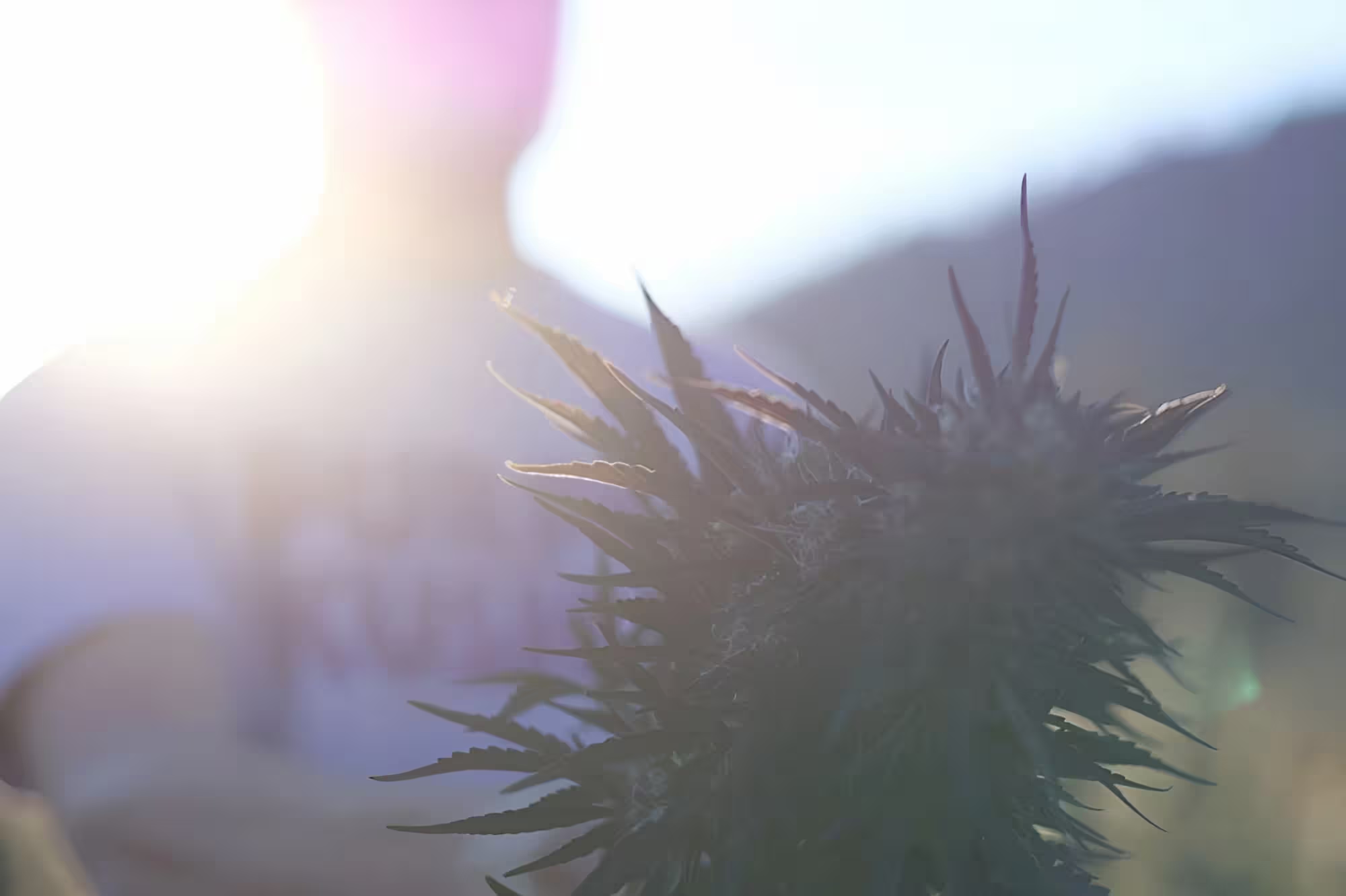


Quick answer: Sungrown cultivation grows cannabis under full, unfiltered sunlight instead of hiding it behind greenhouse glass under artificial light — the same conditions these genetics were originally born under. That full UV spectrum supports the Entourage Effect, where terpenes and cannabinoids work together for a more complete, balanced experience than THC alone can deliver.
The whole industry's obsessed with hiding plants behind glass under artificial light. We think that's backwards. The best strains in history weren't built in a greenhouse. They were born in the dirt, under the open sky.
That's the whole idea behind Open Sky Classic.
We Don't Chase Numbers — We Chase The Real Thing
A plant grown under open sky goes through something hiding behind glass with artificial light can't replicate. Full spectrum sunlight — UVA, UVB, all of it — pushes the plant to build more terpenes. These compounds are the real identity of the plant — its flavour, its aroma, the complexity of what it actually does when you smoke it.
Greenhouse growers chase one number — THC%. Push it up however they can, doesn't matter what gets lost along the way. We're not playing that game. A big THC number means nothing if the terpenes got stripped out by growing it hidden behind glass under artificial light. The plant that emerges is a chemical approximation of the real thing — it has THC, but it's missing everything that makes the experience worth having.
For the full story on why THC percentage is the wrong number to chase, read:
→ The THC Trap — Why The Number On The Label Can't Be Trusted
Open Sky Is Where They're From — Not A Technique
Open Sky isn't something we invented. It's how these genetics were originally grown.
Blue Dream was born under the sun in the Santa Cruz mountains. White Widow was born under the sun in the Dutch lowlands. That's not a growing style choice — that's how the plant came into existence. No glass, no artificial light standing between it and the sky, because none of that was part of the equation yet.
Then the industry got hold of these genetics and hid them behind glass under artificial light — not because it made the weed better, but because it made it easier to control and scale. A generation of cannabis consumers grew up smoking greenhouse versions of strains that were never meant to grow that way. The genetics were the same. The expression was a shadow of what the original plant was capable of.
We're not doing anything new here. We're growing them the way they were born to be grown. BC's interior microclimates — the temperature swings, the altitude, the full-spectrum UV — mirror the birthplaces of these cultivars closer than any grow room ever could.
The Strains
Blue Dream — The Santa Cruz Legend
Born in the Santa Cruz mountains around 2003. Coastal fog in the morning, hard Pacific sun in the afternoon. That temperature swing built a plant that thrives on variation. BC's interior gives it the same conditions — the same swing that triggers the deep blue and purple hues that signify its true lineage. A greenhouse keeps the temperature constant. The Santa Cruz mountains never did, and neither do we.
White Widow — The Queen of the Polders
Born in the Dutch polders in 1994. Flat land near the North Sea, harsh high-refraction light bouncing off the water, salt-tinged wind. Bred to handle a punishing maritime climate. Its signature white resin coating is a genetic defense mechanism — the plant protecting itself from intense light by producing trichomes. BC sun pushes that defense response harder than the cloudy Dutch skies ever could, producing a resin density that greenhouse growing simply can't match.
Pink Kush — The BC Heirloom
Born on Vancouver Island in the nineties. Built for BC's rainforest climate from the start — the humidity, the UV, the coastal temperature swings. Its vivid pink and magenta pistils are a direct response to BC's specific UV spectrum. This is the strain that proves BC genetics can stand with the best in the world. It started here, went global, and it comes home every time we grow it under the same sky that built it.
Northern Lights, OG Kush, Durban Poison, Jack Herer
All born outside. All eventually hidden behind glass under artificial light by an industry that valued control over authenticity. Northern Lights bred for the short sun-drenched summers of the Pacific Northwest — nearly the same latitude as our fields. OG Kush born in salt-tinged Atlantic air, its fuel and lemon aroma a product of full-spectrum light on real terpene chemistry. Durban Poison, a pure landrace from the subtropical sun of South Africa, requiring full sun to trigger its famous clear-headed energy. Jack Herer, named after the Emperor of Hemp, born in the Dutch coast's greenhouse hub — and now finally being liberated from it. We're bringing them all back to the sky.
Why THC Alone Doesn't Tell You Anything
Weed isn't one chemical. It's hundreds of them working together — THC, terpenes, CBD, minor cannabinoids like CBG and CBN. They don't just coexist. They interact. Scientists call it the Entourage Effect, first described by Ben-Shabat and Mechoulam in 1998.¹
A 2024 Johns Hopkins clinical study — one of the first controlled trials of its kind — found that participants who consumed THC combined with limonene experienced significantly less anxiety than those consuming THC alone.² The terpene changed the experience of the THC. Not the THC percentage. The terpene.
A greenhouse flower can hit a big THC number and still smoke like nothing, because the terpenes got stripped out behind glass under artificial light. THC gets you in the door. Everything else is what you actually feel.
The Cost Of Hiding Plants Behind Glass
There's another reason sun-grown matters — and it goes beyond quality. Growing cannabis in Canadian greenhouses through the winter carries significant energy costs and a carbon tax burden that other crops are exempt from. That cost pressure shapes what ends up in pre-rolls across the industry. Read the full story:
→ The Greenhouse Tax — Why You're Paying For Their Electricity Bill
Big Buds, Not Bag Flower
Everything we grow goes into the paper. We don't sell bag flower, and we don't separate the plant into a premium tier and a leftover tier. Big buds, full sun, straight into the pre-roll. That's Smart Value — the natural result of growing it right, not a discount.
Related Reading
→ The THC Trap — Why The Number On The Label Can't Be Trusted
→ The Greenhouse Tax — Why You're Paying For Their Electricity Bill
Sources:
¹ Ben-Shabat, S., et al. (1998). An entourage effect: inactive endogenous fatty acid glycerol esters enhance 2-arachidonoyl-glycerol cannabinoid activity. European Journal of Pharmacology, 353(1), 23–31. https://doi.org/10.1016/s0014-2999(98)00392-6
² Spindle, T.R., et al. (2024). Vaporized D-limonene selectively mitigates the acute anxiogenic effects of Δ9-THC. Drug and Alcohol Dependence, 257, 111267. https://doi.org/10.1016/j.drugalcdep.2024.111267
